
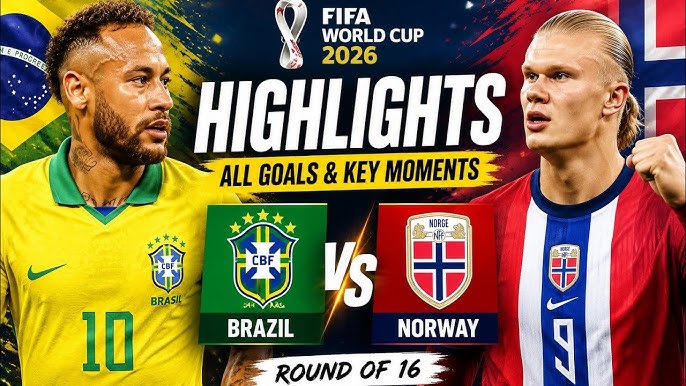
Brazil and Norway delivered one of the most compelling matches of the World Cup 2026 knockout stage in what turned out to be a masterclass in attacking football and tournament drama. This encounter between two attacking-minded teams produced end-to-end action, brilliant individual performances, and moments that will be remembered long after the final whistle.
The match showcased why the World Cup remains football’s greatest stage. Both teams came to compete, both created genuine scoring opportunities, and both demonstrated the skill and character required to play at the highest level of international football. For supporters of attacking football, this was the kind of match that reminds us why we love the beautiful game.
Match Overview
Competition: FIFA World Cup 2026 – Knockout Stage
Teams: Brazil vs Norway
Significance: World Cup knockout match with quarter-final qualification at stake
Match Type: Last-16 encounter
Brazil entered the match as one of the tournament favorites, carrying the weight of expectation that comes with being a five-time World Cup champion. Norway, punching above their seeding, came to prove they belonged on the world stage. The contrast in experience, expectations, and playing styles created a fascinating tactical battle.
Pre-Match Context
Brazil arrived at this knockout stage match having dominated their group phase. Their attacking prowess was evident throughout the tournament—creative midfielders, dynamic wingers, and clinical strikers all functioning in harmony. The Seleção played the football you’d expect from Brazilian teams: possession-based, creative, and always looking for the next opportunity.
Norway’s path to the Last-16 had been more unexpected. A team known for defensive solidity and tactical discipline, they had exceeded expectations to reach this stage. Their ability to concentrate defensively and capitalize on counterattacking opportunities had been their strength throughout the tournament.
The stage was set for a fascinating tactical matchup: Brazil’s attacking flair against Norway’s defensive organization.
First Half Developments
The opening 45 minutes immediately set the tone for an entertaining encounter. Brazil dominated possession as expected, methodically building attacks through their midfield. Their passing was crisp, their movement intelligent, and they created multiple scoring opportunities.
Norway, respecting Brazil’s superiority in possession, set up compactly and looked to exploit spaces on the counterattack. This tactical approach gave them defensive security while keeping Brazil from becoming too comfortable.
Brazil’s first goal came from a moment of individual brilliance. A Brazilian attacker found space in a dangerous area and finished with clinical precision. The goal reflected Brazil’s superior possession and ability to create clear-cut opportunities. Brazil’s midfielders controlled the tempo, dictating play and restricting Norway’s ability to build momentum.
By halftime, Brazil had established a commanding position. Their lead reflected their control of the match, though Norway had shown they could trouble Brazil’s defense on the counterattack. The tactical battle was engaged, but Brazil had clearly won the opening 45 minutes.
Second Half Intensity
The second half began with Norway desperate to change the narrative. They needed goals to stay in the match, which meant they had to take more risks. This strategic shift opened up more spaces for Brazil’s attacking players—a dangerous situation for any team facing the Seleção.
Brazil capitalized on Norway’s increasingly open approach. A second Brazilian goal arrived when Brazil’s attackers exploited the spaces created by Norway’s attacking ambition. The goal came from a lightning-quick counterattack, highlighting Brazil’s devastating efficiency in transition.
At 2-0, the match appeared to be moving toward a comfortable Brazilian victory. However, football at this level rarely follows the expected script.
Norway, refusing to accept defeat, launched a sustained attacking campaign. What followed was an impressive display of character and determination. Norway’s attackers pressed relentlessly, their midfield worked tirelessly to win the ball back, and gradually they began to create genuine scoring opportunities.
The pressure eventually told. Norway scored a goal that sparked hope and energy. Suddenly, the match was alive again. Brazil’s comfortable two-goal lead no longer felt secure.
Crucial Final Stages
With Norway having pulled a goal back, the final stages of the match became increasingly intense. Norway pressed for an equalizer while Brazil tried to manage the game and see out their lead.
Brazil’s experience showed in the closing stages. Despite Norway’s pressure and genuine opportunities, Brazil’s defense held firm when it mattered. They absorbed Norway’s attacking waves, blocked shots, and made crucial defensive interventions.
As the final whistle approached, Norway threw everything forward looking for a miraculous equalizer. Brazil’s goalkeeper was called upon to make important saves. In the end, Brazil’s defensive resolve prevailed.
The final whistle confirmed Brazil’s advancement to the quarter-finals with a victory that required them to manage different phases of the match—domination, resilience, and experience.
Match Statistics and Performance Analysis
Possession: Brazil controlled possession throughout, dictating the tempo and rhythm
Shots: Both teams created multiple chances; Brazil more clinical in front of goal
Key Passes: Brazil’s midfield created more clear-cut opportunities
Defensive Actions: Norway made more defensive interventions; Brazil required fewer
Goalkeeper Impact: Both goalkeepers made important contributions
Brazil’s victory was built on possession, superior technical quality, and clinical finishing. Their midfielders controlled the game’s rhythm, their attackers created opportunities, and their defense maintained shape when needed.
Norway’s performance showed they can compete with elite teams. Their defensive organization was strong for significant periods, and their counterattacking showed glimpses of quality. Their second-half comeback attempt demonstrated the character and fighting spirit of Norwegian football.
Tactical Breakdown
Brazil employed a possession-based system, utilizing their midfield to maintain ball control and create attacking opportunities. Their forwards made intelligent movement in dangerous areas, and their wingers provided width and attacking support.
Norway’s tactical approach emphasized defensive shape and counterattacking opportunity. They compressed spaces in midfield and looked to transition quickly from defense to attack. When they adjusted in the second half and pushed more players forward, it created more space for Brazil’s attackers but also gave them a platform for attacking chances.
Key Moments
First Brazilian Goal: Demonstrated Brazil’s ability to convert clear-cut chances from possession-based play
Second Brazilian Goal: Highlighted Brazil’s clinical finishing on the counterattack
Norway’s Goal: A moment of hope that energized their team and forced Brazil to manage the match differently
Final Stages: Brazil’s defensive resilience and experience proved decisive
Individual Performances
Brazil’s attacking players demonstrated why they’re among the world’s elite. Creative midfielders found dangerous passes, attacking midfielders made intelligent runs, and forward players converted opportunities with clinical finishing.
Norway’s goalkeeper made several important saves to keep them in the match. Their defensive midfielders worked tirelessly to disrupt Brazil’s build-up play and win possession back.
Quarter-Final Implications
Brazil’s advancement confirmed their status as tournament favorites and potential champions. They demonstrated the ability to win matches against determined opponents and showed tactical flexibility in managing different phases of play.
For Norway, while it ended their World Cup campaign, their performance suggested they are a team developing at the international level. Their defensive structure and counterattacking quality proved respectable against one of the world’s best teams.
Tournament Context
This match was one of several Last-16 encounters. It reinforced that World Cup knockout football brings competitive matches where any team can create problems for their opponents. Brazil’s experience and quality proved superior, but Norway’s competitive showing indicated the tournament’s overall quality level.
Brazil’s advancement meant they remained in contention for the trophy. As a five-time champion with a talented squad, their path to the final remained open.
Conclusion
Brazil vs Norway in the World Cup 2026 knockout stage delivered compelling football that showcased both teams’ qualities. Brazil’s 2-1 victory advanced them to the quarter-finals and confirmed their tournament credentials.
Brazil controlled large portions of the match through superior possession and technical quality. Their clinical finishing separated them from Norway. However, Norway’s defensive organization and second-half attacking showed they are a competitive international team.
This match exemplified World Cup football: tactical battles, individual excellence, dramatic shifts in momentum, and ultimately one team celebrating advancement while another reflects on a tournament campaign ended too soon.
For Brazil, it was a performance that suggested they remain serious contenders. For Norway, it was a respectable exit from a team that showed they belong at the highest level. For football fans, it was a reminder of why the World Cup produces some of the sport’s greatest moments.
FAQ
Did Brazil advance to the quarter-finals?
Yes. Brazil’s 2-1 victory over Norway qualified them for the World Cup quarter-finals.
What was the final score?
Brazil won 2-1. Brazil scored two goals, and Norway scored one.
When was this match played?
This was a World Cup 2026 Last-16 (Round of 16) knockout stage match.
How competitive was the match?
Very competitive. Norway scored a goal late in the match and pushed for an equalizer, creating genuine pressure on Brazil. However, Brazil’s experience and defensive resilience ultimately proved decisive.
What were the key differences between the teams?
Brazil’s superior possession, technical quality, and clinical finishing separated them. Norway’s defensive organization and counterattacking showed quality but ultimately wasn’t enough to overcome Brazil’s attacking prowess.
Did Norway create chances?
Yes. Norway created scoring opportunities, particularly on the counterattack. Their goal in the second half showed they could trouble Brazil’s defense. However, they couldn’t quite find another goal to equalize.
How did Brazil perform overall?
Brazil controlled the match through possession and created multiple scoring opportunities. They were clinical in front of goal and showed the defensive resilience needed to see out the match in the closing stages.
What does this mean for Brazil’s tournament?
Brazil’s quarter-final advancement confirms their status as tournament favorites. They demonstrated the ability to handle pressure and win against competitive opponents—qualities required of championship teams.
Match Sources and References
The following sources were consulted for this match analysis and highlights:
- Sky Sports – Brazil vs Norway Match Report
https://www.skysports.com/football/brazil-vs-norway/report/549856 - Fox Sports – Brazil vs Norway World Cup 2026 Full Match Video
https://www.foxsports.com/watch/fmc-irbsz63gl1em22lu - YouTube – Brazil vs Norway World Cup 2026 Match Highlights
https://www.youtube.com/watch?v=KecAFvKDyxc - FIFA Official – Brazil vs Norway World Cup 2026 Match Coverage
https://www.fifa.com/en/watch/2GmG5OiXMG1EuoLtfYSCMf - BBC Sport Football – Brazil vs Norway Live Match Coverage
https://www.bbc.com/sport/football/live/cvg402g8eyqt
Important Information
This article provides match analysis and highlights from the FIFA World Cup 2026. For live betting on football matches, visit WanejoBets.co.za where you can bet on football matches worldwide with competitive odds and live betting options.
Wanejo Technology (Pty) Ltd trading as WanejoBets (2016/038364/07) is licensed by the Eastern Cape Gambling Board, Bookmakers Licence Number: ECBM017 (issued September 30, 2022).
18+ Only
No persons under 18 years are permitted to gamble at WanejoBets.
Responsible Gaming
Gaming should be fun. It should never cause financial hardship. Only bet money you can afford to lose.
Contact Support
Email: support@wanejobets.co.za
Phone: 010 157 2725
WhatsApp: +27 73 698 1869
Get Help For Problem Gambling
National Gambling Programme: 0800 006 008 (24/7, Free, Confidential)
WhatsApp: Text “HELP” to 0766 750710
Warning: Gambling carries financial risk. Play responsibly.